Whole-Home Mold Remediation in Salt Lake City, UT
You came back from a week away in February to a Sandy house where the furnace had quit and a supply line in the garage wall had split. Water ran down into the finished basement for three days, and by the time you pulled the carpet back in the family room the pad was black and the smell had reached the top of the stairs. Every room downstairs is wet, and the walls that share the garage are wet upstairs too. This site connects you by phone with an independent local provider who does whole-home mold remediation in Salt Lake City and across Salt Lake County.
Mapping a basement that soaked through wall to wall
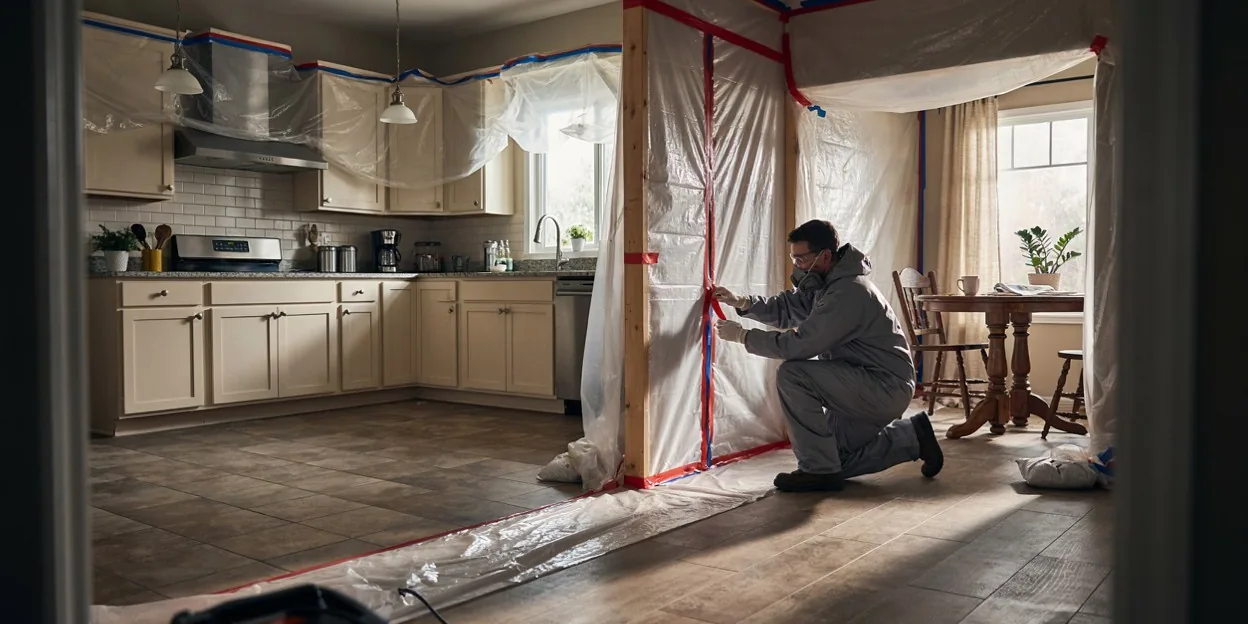
The crew meters every room on the lowest floor, not just the ones that smell: the slab under each carpet, the base of every wall, the back of the stairs, and the walls upstairs that stack over wet ones. They draw the readings on a floor plan and divide the house into zones, and that drawing becomes the scope. On a job this size the containment is the whole stairwell and the furnace room, with the ductwork sealed off so the blower cannot move basement air through the house.
The furnace itself gets looked at early. In most Salt Lake homes the air handler sits in the basement, often in the wettest corner, and a wet filter cabinet or a damp plenum means the rest of the house has been breathing the basement for weeks.
Shut the main, open the windows upstairs, and stay out of the basement
Close the water main and the valve to the water heater. Open windows on the main floor for a few hours if the weather allows, and keep the basement door shut. Do not start hauling wet carpet up the stairs; every armload spreads what is in it through the rooms you still have.
Photograph each room from the doorway and write down the date the water started if you know it. Move what you can carry out of the dry rooms upstairs, since those become staging space. Call your carrier the same day; a split pipe is the kind of loss most policies respond to, and the date matters.
Zones cleared in order, the furnace last
The crew works one zone at a time behind plastic, starting at the source and moving away from it. In each zone the carpet, pad, wet drywall, and insulation come out to the meter line and leave in bags; the framing, slab, and foundation walls are HEPA vacuumed, wiped, and dried. Air movers and dehumidifiers run until each zone reads dry before the next is opened, and the readings go on the same floor plan the scope came from.
The furnace room is cleared last, with the plenum and the first duct runs cleaned under HVAC mold cleaning. A bathroom that was part of the loss is handled under bathroom mold removal. Rebuilding the whole floor, drywall through carpet, is mold damage repair, and the provider tells you where their work ends and the rebuild begins.
Cold snaps, saturated springs, and basements that were someone's whole downstairs
Salt Lake winters put a hard freeze on exterior walls, and a supply line run through a garage wall or an uninsulated rim joist splits when a furnace fails or a door is left open. The spring side is slower but just as total: the record snowpack of 2023 raised groundwater across the valley, and basements from Rose Park to Draper took water through every wall at once rather than one window well. Either way, a finished basement is often half the home's living space, and the loss runs room to room.
Utah does not license mold work, so the provider represents its own training; the rebuild falls under a Utah contractor license and usually a permit from your city. A sudden pipe break is a covered loss on most Utah policies, groundwater usually is not, and mold itself sits under a cap on many of them. Have the moisture map and the photos ready for the adjuster.
When you call about a house that is wet from end to end
Have the address, how many rooms are wet, and what started it: a pipe, the melt, or something else. Say when the water started, whether the furnace is in the basement, and whether anyone in the house has trouble breathing around mold. Call (801) 457-5486.